





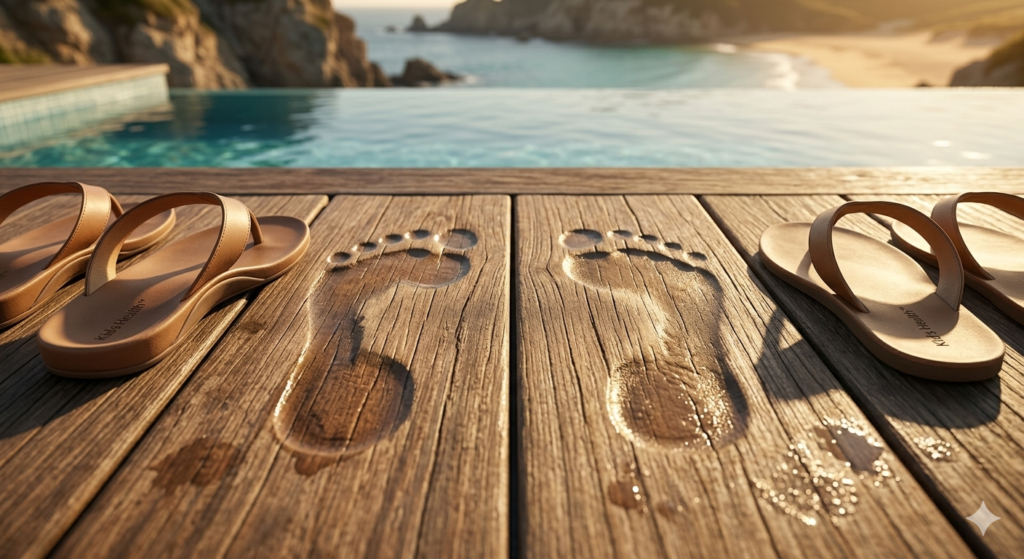
Have you ever stepped out of a swimming pool and looked back at the wet footprints you left on the concrete? Those fleeting shapes actually tell a much bigger story than you might realize. Some people leave a solid, heavy imprint that looks like a giant bean, while others leave only a faint mark of a heel and the ball of the foot, with almost nothing in between.
Those shapes are the first clue to understanding your foot architecture. Whether you have flat feet, high arches, or something in between, your arch type dictates how your body absorbs shock, how you walk, and why certain parts of your body might ache after a long day.
Knowing your foot type isn’t just for athletes or people buying expensive running shoes. It is for anyone who wants to avoid nagging knee pain, lower back stiffness, or that localized “tired” feeling in the feet. Most of us go through life without ever really looking at our feet until they start to hurt. By then, the “fallen arch” or the “rigid high arch” has already started affecting the joints further up the chain.
The Mechanics of the Human Arch
Before you can figure out which category you fall into, it helps to understand what the arch actually does. Think of your foot as a sophisticated suspension system for your body. If the foot were a solid block of bone, every step you took would send a jarring shockwave straight into your shins and knees.
The arch is designed to be a flexible bridge. It’s held together by a complex web of ligaments and the plantar fascia—a thick band of tissue that acts like a bowstring. When your weight comes down, the arch “gives” slightly, spreading the load and storing energy. When you lift your foot, that energy is released to help propel you forward.
When this bridge is too low (flat feet), the “suspension” is essentially bottomed out. When the bridge is too high, the “suspension” is too stiff to move. Both scenarios create unique challenges for your body’s mechanics.
The Most Reliable Home Tests
You don’t necessarily need a medical degree or a high-tech gait analysis to get a good idea of where you stand. There are a few tried-and-true methods you can perform in your own living room or bathroom.
1. The Wet Test (The Gold Standard)
This is the most famous method for a reason: it provides a clear visual.
- Pour a thin layer of water into a shallow pan.
- Wet the sole of your foot thoroughly.
- Step firmly onto a piece of heavy paper, a paper bag, or even a dry concrete walkway.
- Step off and look at the mark.
If you see a full footprint: You likely have flat feet. The entire sole of your foot is making contact with the ground.
If you see about half of the arch area filled in: You have a neutral or “normal” arch.
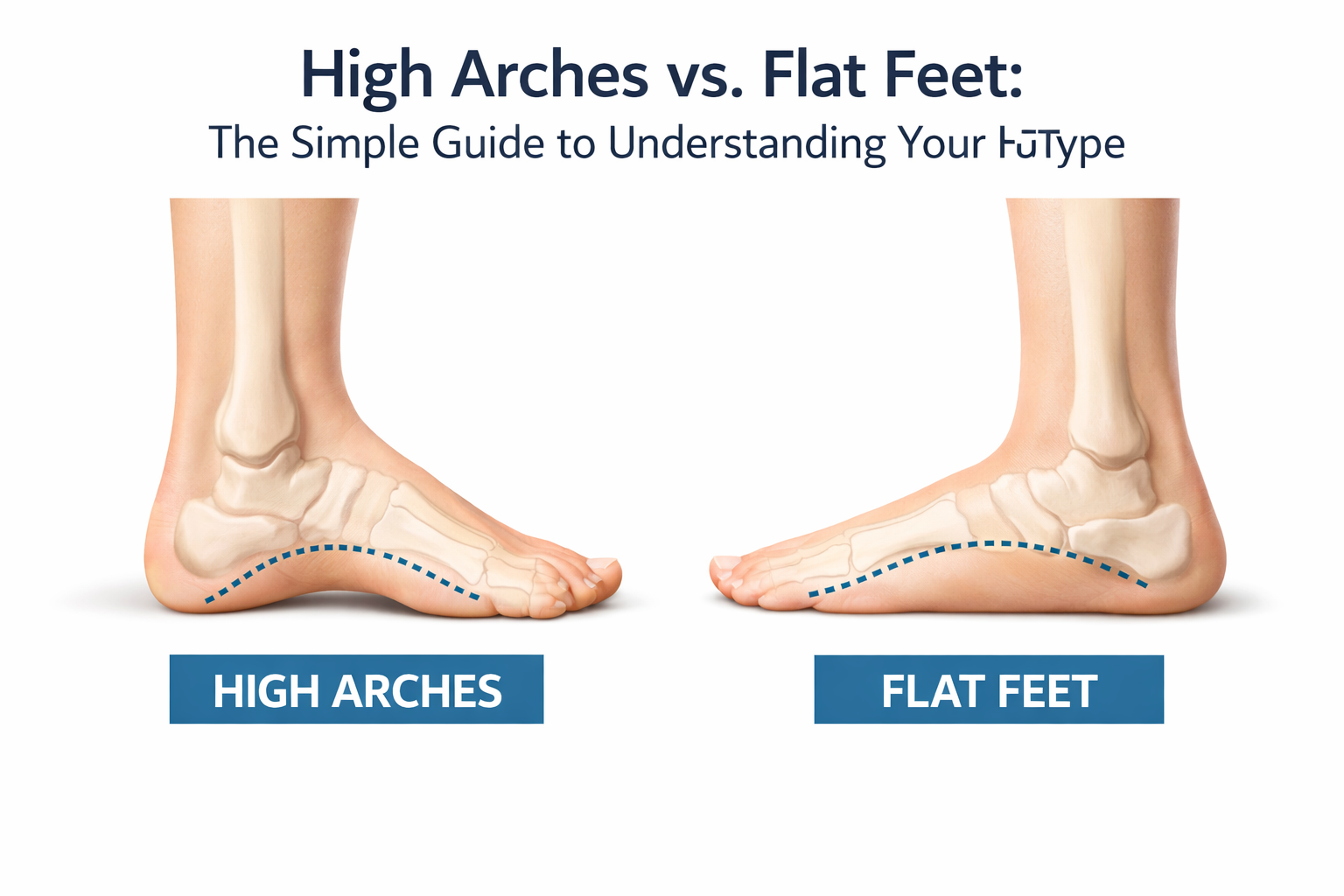
If you see only the heel and the ball of the foot with a very thin line (or nothing) connecting them: You have high arches.
2. The Wear Pattern Test
Your old shoes are like a historical record of how you move. Flip over a pair of sneakers you’ve worn for at least six months and look at the tread on the bottom.
- Flat Feet (Overpronation): You will likely see more wear on the inside edge of the sole, especially near the big toe and the inner side of the heel.
- High Arches (Supination): You will see the most wear along the outside edge of the shoe.
- Neutral Arches: The wear will be fairly even, perhaps slightly more toward the center of the ball of the foot and the outside of the heel.
3. The Finger Test
While sitting down, place your foot flat on the floor. Try to slide your index finger under the arch of your foot.
- If you can’t get your finger under there at all, you have flat feet.
- If your finger slides in easily but stops at the first joint, you’re likely neutral.
- If you can slide almost your entire finger under the arch without touching the top of your foot, you have high arches.
Deep Dive: Living with Flat Feet (Pes Planus)
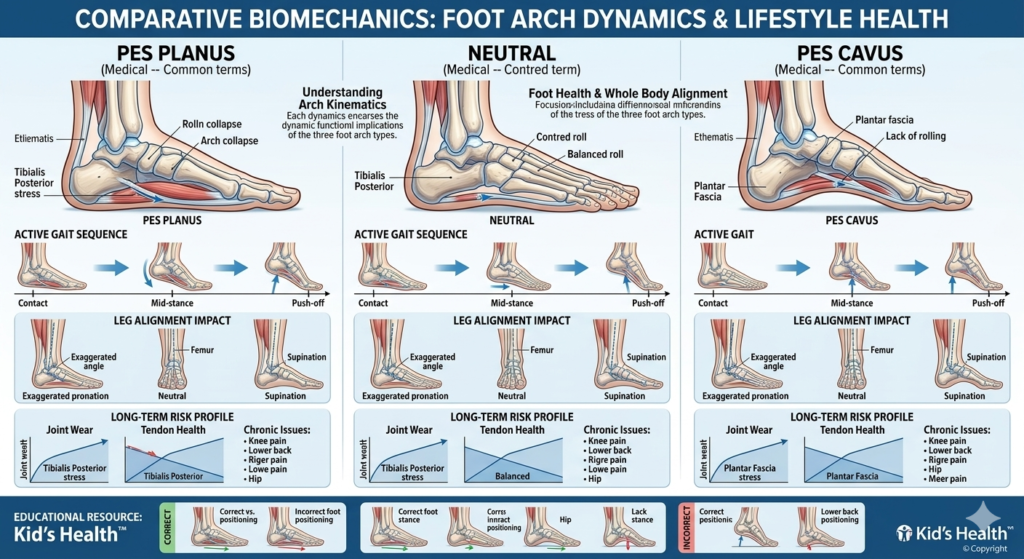
If your footprints look like solid blocks, you have what is medically known as pes planus. Flat feet come in two varieties: functional and structural.
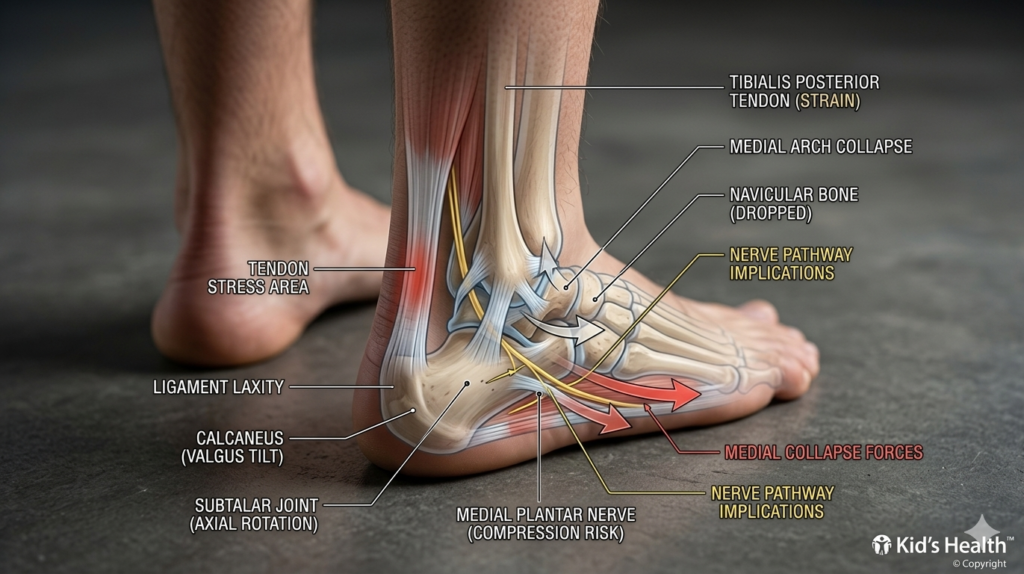
Structural flat feet are something you are born with. The bones are shaped in a way that the arch never truly forms. Functional flat feet (often called “fallen arches”) happen over time. This can be due to age, weight gain, pregnancy, or simply wearing unsupportive shoes for decades. The posterior tibial tendon, which supports the arch, can weaken or stretch, causing the arch to collapse.
What You Might Feel:
If you have flat feet, you probably notice that your ankles seem to “roll in” when you walk. This is called overpronation. Over time, this inward roll causes the lower leg to rotate, which can lead to:
- Aching in the arches or heels.
- Pain in the shins (shin splints).
- Knee pain, specifically on the inner side.
- Lower back fatigue after standing for long periods.
The “benefit” of flat feet is that they are generally flexible. The downside is that they lack the stability needed to protect your joints from repetitive stress.
Deep Dive: Living with High Arches (Pes Cavus)
On the opposite end of the spectrum are high arches, or pes cavus. This condition is much less common than flat feet, but it can be just as troublesome. High arches are often hereditary, though in some cases, they can be linked to neurological conditions.
Unlike flat feet, which are “too loose,” high-arched feet are “too tight.” Because the arch is so high and rigid, the foot doesn’t flatten much when it hits the ground. This means the shock of every step isn’t absorbed by the arch; instead, it’s sent directly into the bones of the foot and up into the ankles and knees.
What You Might Feel:
People with high arches often suffer from “supination”—meaning their weight stays on the outer edges of their feet. You might notice:
- Frequent ankle sprains because the foot is unstable.
- Calluses on the ball of the foot or the outer edge.
- Hammer toes or claw toes, as the tendons are constantly under high tension.
- Pain in the heel or ball of the foot (metatarsalgia).
How Your Arch Type Affects Your Whole Body
It is a mistake to think of foot issues as staying “in the feet.” Your body is a kinetic chain. Think of it like a house: if the foundation is tilted, the windows on the second floor won’t open properly.
When you have flat feet and your ankles roll in, your knees have to rotate to compensate. This puts uneven pressure on the cartilage in your knee joints. If you’ve ever had “mysterious” knee pain that doesn’t go away with rest, the culprit might actually be your flat feet.
Conversely, high arches can cause issues all the way up to the neck. Because high-arched feet are poor shock absorbers, the vibration of walking on pavement travels up the skeleton. This can manifest as chronic lower back pain or even tension headaches in extreme cases.
You might also notice that your posture changes based on your arches. Flat-footed individuals often develop a slight “slouch” in the lower back (anterior pelvic tilt), while those with high arches may have more rigid, upright, and easily fatigued back muscles.
Practical Solutions and Tips
The good news is that once you know your foot type, you can make small changes that lead to massive improvements in how you feel.
For Flat Feet:
- Focus on Stability: Look for shoes labeled “motion control” or “stability.” These have firmer foam on the inside of the arch to stop the inward roll.
- Strengthen the Arch: Simple exercises like “towel curls”—where you sit and use your toes to scrunch up a towel on the floor—can help strengthen the intrinsic muscles of the foot.
- Supportive Sandals: As discussed earlier, avoid flat flip-flops. Choose sandals with a built-in, firm arch support.
For High Arches:
- Focus on Cushioning: Since your feet don’t absorb shock, your shoes must do it for you. Look for “neutral cushioned” shoes with plenty of soft foam.
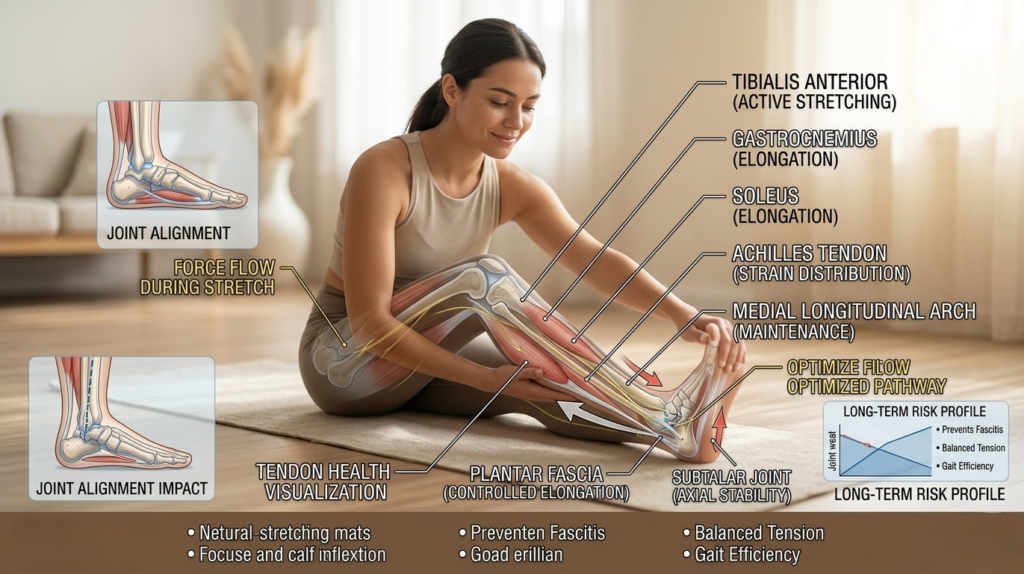
- Flexibility is Key: High arches are often accompanied by tight calves. Stretching your Achilles tendon and calf muscles daily can take a lot of pressure off your arches.
- Avoid Rigid Soles: You want a shoe that can flex and move with you, providing a “soft landing” for every step.
Expert Insights: When to Seek Professional Help
While home tests are a great starting point, they aren’t a substitute for a professional evaluation if you are in chronic pain. A podiatrist can use a “force plate” to see exactly where your weight is distributed as you walk.
One thing experts often point out is that “flat feet” aren’t always a problem. If you have flat feet but zero pain in your knees, back, or feet, you might not need to do anything at all. Some of the world’s fastest marathon runners have flat feet. The problem only arises when the foot’s structure causes a “malalignment” that leads to tissue damage or joint strain.
However, if you notice that one foot is significantly flatter than the other, or if your arch has collapsed suddenly, you should see a doctor immediately. This could indicate a tendon tear or a more serious structural issue that requires more than just better shoes.
The Path to Better Foot Health
Understanding your arches is a bit like finding out your blood type or your eye prescription. It’s a fundamental piece of information about how your body is built. Once you know if you are a “flat-footer” or a “high-archer,” the world of footwear becomes much easier to navigate.
You stop buying shoes based on how they look on the shelf and start buying them based on how they support your foundation. You might notice that after a few weeks of wearing the right support, that “normal” back pain you’ve had for years starts to fade. Or that “old running injury” in your knee finally clears up.
Our feet are the only part of our body that makes contact with the earth. Every mile you walk, every hour you stand, and every step you take is filtered through your arches. By taking ten minutes to perform a “wet test” or look at your old shoes, you are taking a major step toward a more comfortable, active life.
FAQ
Can my arch type change over time?
Yes. While high arches are usually stable throughout adulthood, arches can “fall” over time. Aging, significant weight gain, and pregnancy all put extra stress on the ligaments. This can cause a neutral foot to become flat or a flat foot to become even more pronounced.
Do I need custom orthotics if I have flat feet?
Not necessarily. Many people find relief with high-quality, over-the-counter insoles or simply by choosing the right category of shoe. Custom orthotics are usually reserved for people with severe pain or significant structural deformities.
Why do my high arches hurt more in the morning?
This is often due to the plantar fascia tightening up while you sleep. When you take those first steps in the morning, you are forcefully stretching a “cold” and rigid arch. Gentle stretching before you get out of bed can help.
Is it okay for kids to have flat feet?
Yes. Almost all toddlers have flat feet because their arches haven’t developed yet and are covered by a “fat pad.” Most children develop a visible arch by age 6 or 7. If a child is experiencing pain or limping, then it’s time to see a specialist.
Can exercise “fix” flat feet?
Exercise can strengthen the muscles that support the arch, making a “functional” flat foot much more stable and less painful. However, it cannot change the actual bone structure of a “structural” flat foot.
Are high arches better for running?
Not necessarily. While high arches are often associated with speed, they are also prone to stress fractures because they don’t absorb shock well. Neither type is “better”—they just require different types of care and footwear.