





If your foot rolls inward when you walk, you’re not broken—you’re pronating. Pronation is a natural, essential movement that allows your foot to absorb shock, adapt to terrain, and propel you forward efficiently. It happens every time your foot strikes the ground, flattens slightly, and transitions into push-off. Without it, walking would be jarring, inefficient, and far more likely to cause injury.
Yet, pronation often gets a bad rap. Many people assume it’s a problem to be corrected—especially when they hear terms like overpronation or supination. But the truth is: pronation itself is not the enemy. It’s a critical part of healthy gait. The issue arises when the motion becomes too much, too fast, too slow, or poorly timed. Understanding how pronation works—and why it’s necessary—can help you make smarter choices about footwear, exercise, and injury prevention.
In this guide, you’ll learn exactly what pronation is, how it supports normal walking, the three main types (neutral, overpronation, and underpronation), and how to recognize if your gait is working for you—or against you.
How Pronation Works in Walking

Pronation isn’t just “rolling in.” It’s a complex, three-dimensional motion involving multiple joints and planes of movement. This triplanar action allows the foot to shift from a flexible shock absorber at impact to a rigid lever for push-off.
Inward Roll and Arch Flattening
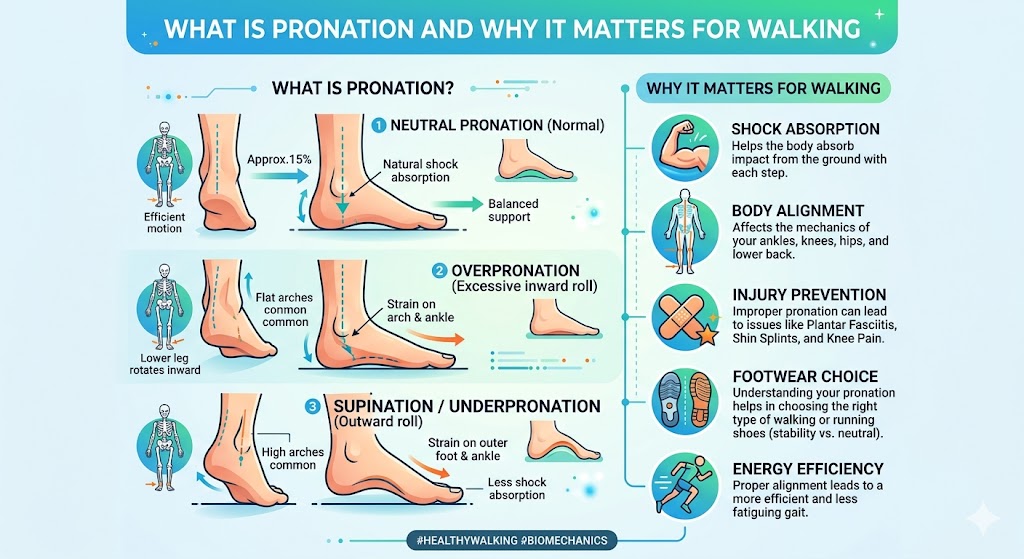
When your heel hits the ground, your foot naturally rolls inward—about 15% in a healthy gait. This eversion at the subtalar joint lowers the medial arch slightly. Think of it like a spring compressing: the foot spreads out to absorb the force of impact, which can reach up to 2.5 times your body weight during walking.
That slight flattening isn’t weakness—it’s function. It helps distribute pressure across the foot, protecting bones, joints, and soft tissues from concentrated stress.
Tibial Rotation and Force Distribution
As the foot pronates, it triggers a chain reaction up the leg. The tibia (shin bone) rotates inward, helping transfer forces smoothly through the knee, hip, and spine. This controlled internal rotation is part of the body’s natural shock-dissipation system.
Without this motion, impact would travel straight up the leg with little absorption, increasing strain on joints and raising the risk of overuse injuries.
From Flexible to Rigid: The Gait Transition
Pronation dominates the early stance phase of walking—heel strike through midstance. But as your body moves over your foot, the motion reverses. The foot begins to supinate, tightening ligaments and locking joints to form a rigid structure for push-off.
This shift—from mobile adapter to rigid lever—is only possible because of proper pronation earlier in the cycle. If the foot skips pronation, it can’t resupinate effectively, leading to inefficient propulsion and muscle fatigue.
Why Pronation Is Essential for Walking
Pronation isn’t an accident of evolution—it’s a finely tuned mechanism that supports every step you take. Here’s why it’s indispensable.
Absorbs Impact Forces
Every time your foot hits the ground, it must cushion the collision. Pronation allows the arch and midfoot joints to act like a built-in suspension system. Without it, bones and cartilage would bear the brunt of each step, increasing wear and injury risk.
Runners and walkers alike depend on this shock absorption. Even small disruptions in pronation can amplify stress on the plantar fascia, Achilles tendon, and knees.
Adapts to Uneven Surfaces
Nature isn’t flat. Whether you’re walking on grass, pavement, or gravel, your foot needs to conform to the surface. Pronation provides the flexibility to maintain balance and prevent ankle rolls on sloped or irregular terrain.
A foot that can’t pronate enough (supinated) is stiff and unstable on uneven ground—prone to sprains and missteps.
Distributes Weight Evenly
During neutral pronation, weight follows a smooth S-shaped path: from the outer heel, across the midfoot, and through the big toe. This even distribution prevents excessive pressure on any one area.
When pronation is off-kilter, pressure shifts abnormally—leading to calluses, stress fractures, or joint pain.
Enables Efficient Push-Off
Pronation sets the stage for supination. By unlocking the foot during loading, it allows the bones and ligaments to realign into a stable platform for propulsion.
Without this sequence, push-off becomes weak and inefficient, forcing muscles like the calf and glutes to overwork.
Supports Whole-Body Alignment
Your feet are the foundation of your posture. Controlled pronation helps keep the lower limb aligned, reducing rotational stress on the knees and hips.
Excessive or mistimed pronation, however, can tilt the pelvis, twist the knee, and contribute to lower back pain—a classic example of how a foot issue can ripple up the kinetic chain.
Three Types of Pronation Explained
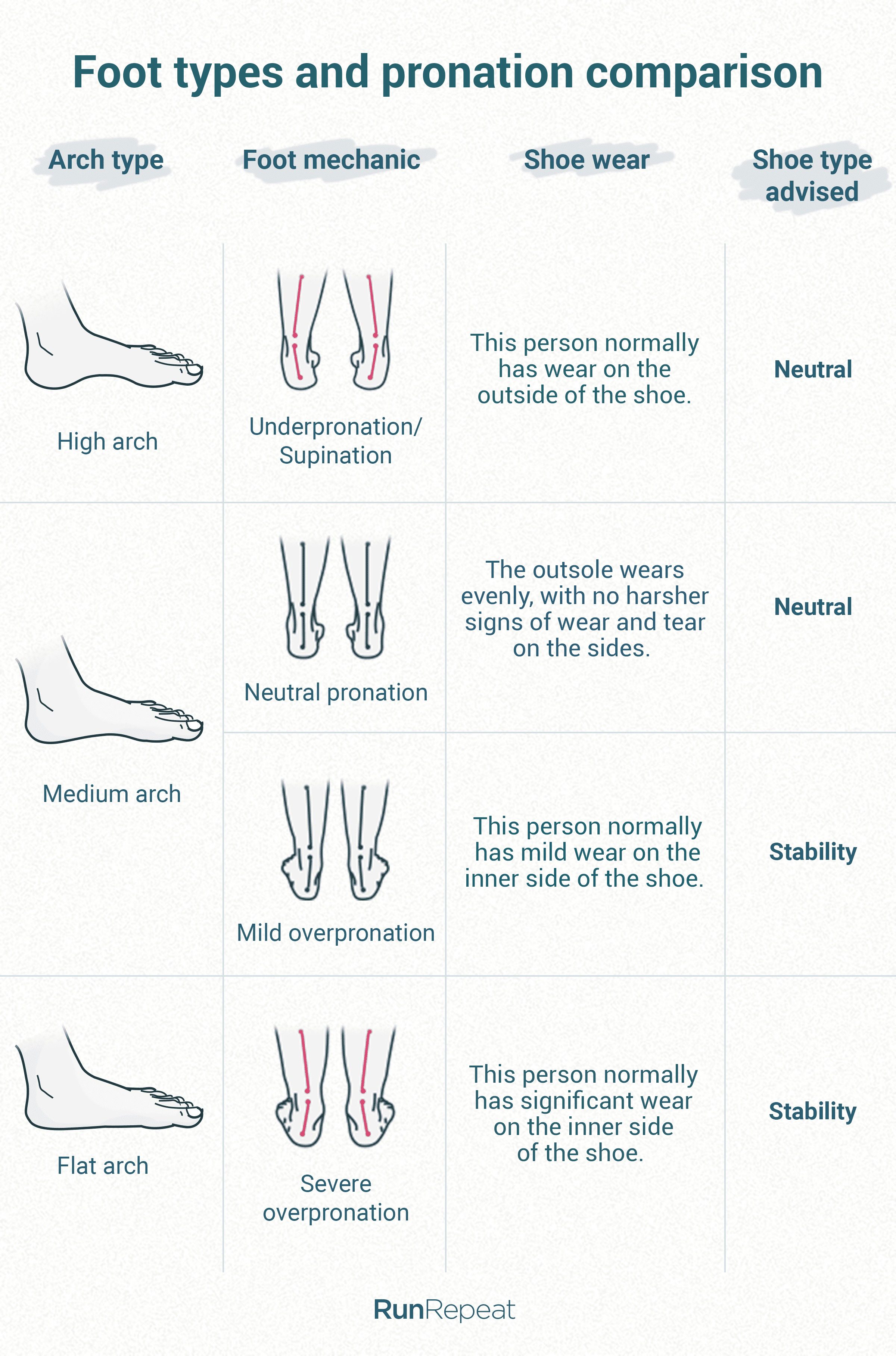
Not all pronation is the same. The degree and timing of inward roll determine whether your gait is balanced—or setting you up for trouble.
Neutral Pronation: The Gold Standard
- Inward roll: ~15%, smooth and controlled
- Arch behavior: Slight flattening, then re-stiffens
- Footwear wear: Outer heel to inner forefoot, balanced
- Who it affects: Most people with medium arches
Neutral pronation means your foot functions optimally—absorbing shock, distributing load, and transitioning efficiently to push-off. It’s associated with lower injury risk and efficient energy transfer.
Overpronation: Too Much Inward Roll
- Inward roll: >15%, often with arch collapse
- Common causes: Flat feet, weak tibialis posterior, obesity
- Footprint test: Full or nearly full sole imprint
- Shoe wear: Excessive inner heel and big toe wear
Overpronation keeps the foot too flexible for too long, delaying supination. This means the foot isn’t rigid when it needs to push off—leading to muscle fatigue and joint strain.
Associated injuries:
– Plantar fasciitis
– Shin splints
– Achilles tendonitis
– Bunions
– Knee and hip pain
Underpronation (Supination): Not Enough Roll
- Inward roll: Minimal or absent
- Common causes: High arches, tight calves, rigid feet
- Footprint test: Only heel and forefoot visible
- Shoe wear: Outer edge of sole worn down
Supinators land and push off on the outer edge of the foot. Because the foot doesn’t unlock properly, shock absorption is poor, and impact concentrates on the heel and forefoot.
Associated injuries:
– Ankle sprains
– Stress fractures (especially 5th metatarsal)
– Iliotibial (IT) band syndrome
– Plantar fasciitis (from high-impact loading)
How to Check Your Pronation Type
You don’t need expensive equipment to get a clue about your gait. These simple methods can help identify your pronation pattern.
Shoe Wear Analysis
Look at your most-worn walking or running shoes from behind:
- Tilted inward? → Likely overpronation
- Tilted outward? → Likely supination
- Even wear? → Neutral pronation
Also check the sole:
– Inner heel and big toe wear = overpronation
– Outer edge wear = supination
– S-shaped wear = neutral
Wet Foot Test
Wet your bare foot and step on a dark surface (like a brown paper bag):
- Flat imprint (full foot) → Overpronation
- Narrow band or no arch → Supination
- Moderate arch contact → Neutral
This test gives a quick snapshot of your arch’s behavior under weight.
Home Gait Video Check
Record yourself walking barefoot from behind and the side:
- Heel tilts inward quickly? Arch collapses? → Overpronation
- Foot stays on outer edge? Little inward roll? → Supination
- Smooth, moderate inward roll? → Neutral
Watch for symmetry—do both feet move the same way?
Professional Gait Analysis
For accurate diagnosis, see a podiatrist or physical therapist. They use:
- Treadmill video analysis with slow-motion playback
- Pressure mapping to show weight distribution
- Force plates to measure timing and force
- 3D motion capture in clinical settings
These tools detect not just how much you pronate—but when and how fast, which matters just as much.
When Pronation Becomes a Problem
Even slight deviations from neutral pronation aren’t automatically harmful. But uncontrolled, excessive, or mistimed motion increases injury risk over time.
Overpronation Risks
- Plantar fasciitis: Arch collapse strains the plantar fascia
- Posterior tibial tendon dysfunction (PTTD): Overuse of the arch-supporting tendon
- Shin splints: Medial tibial stress from prolonged pronation
- Knee pain: Internal tibial rotation stresses the medial knee
- Hip and back pain: Altered pelvic alignment
The longer the foot stays pronated, the more muscles must work to stabilize it—leading to fatigue and compensation.
Supination Risks
- Ankle instability: Lateral ligaments are vulnerable to sprains
- Stress fractures: High impact on small areas (e.g., metatarsals)
- Metatarsalgia: Pain under the ball of the foot
- IT band syndrome: Increased tension due to lack of internal rotation
- Calf and Achilles strain: Tight muscles absorb less shock
Because supinators lack natural cushioning, they often need extra shock-absorbing footwear.
Fixing Pronation: Shoes, Inserts, and Support
You can’t—and shouldn’t—eliminate pronation. But you can optimize it with the right support.
Choose the Right Shoe Type
| Pronation Type | Shoe Type | Key Features | Examples |
|---|---|---|---|
| Neutral | Cushioned | Lightweight, flexible, responsive | ASICS GEL-CUMULUS®, GEL-NIMBUS® |
| Overpronation | Stability/Motion Control | Medial post, firm midsole | ASICS GEL-KAYANO®, GT-2000™ |
| Supination | Maximal Cushioning | Soft midsole, high rebound | ASICS NOVABLAST®, GEL-NIMBUS® |
Avoid one-size-fits-all advice. A stability shoe for overpronation can harm a supinator by restricting needed motion.
Use Orthotics Wisely
- Custom orthotics: Prescribed after gait analysis; correct alignment and redistribute pressure
- Over-the-counter insoles: Good for mild cases—look for arch support (overpronators) or cushioning (supinators)
Types:
– Functional orthotics: Control motion (e.g., limit overpronation)
– Accommodative orthotics: Provide cushioning (e.g., for high arches or diabetes)
Key Shoe Features to Look For
- Arch support: Matches your arch height
- Stable midsole: Dual-density foam (e.g., ASICS DUOMAX™) for overpronators
- Cushioning: Critical for supinators
- Heel counter: Firm cup to control rearfoot motion
- Flexible forefoot: Allows natural toe-off
- Wide toe box: Lets toes spread naturally
Strengthen, Stretch, and Retrain
Footwear helps—but long-term improvement comes from active correction.
Strengthen Your Feet
- Towel curls: Place a towel on the floor; use toes to pull it toward you
- Marble pickups: Pick up marbles with your toes, drop into a cup
- Short foot exercise: Contract the arch without curling toes—strengthens intrinsic muscles
- Calf raises: Build strength in gastrocnemius and soleus
- Glute bridges: Improve hip stability to reduce foot compensation
Do these 3–4 times a week for lasting results.
Stretch Tight Muscles
- Calf stretch (gastrocnemius): Step into a lunge, back heel down, knee straight
- Soleus stretch: Same position, but bend back knee
- Plantar fascia stretch: Pull toes back toward shin; or roll foot on a frozen water bottle
Tight calves contribute to both over- and under-pronation.
Try Taping or Bracing
- Kinesiology tape: Supports the arch during activity—can reduce overpronation
- Ankle braces: Help supinators avoid lateral sprains during sports or hiking
Use temporarily while building strength.
Consider Gait Retraining
Physical therapists use real-time feedback (video, sensors) to help you:
– Reduce excessive inward roll
– Improve foot strike timing
– Enhance cadence and stride
Even small changes—like increasing step rate by 5–10%—can reduce pronation-related stress.
Midfoot Stiffness: A Hidden Cause of Dysfunction
Recent research shows that midfoot joint stiffness—not just arch height—can disrupt pronation. A stiff midfoot prevents smooth load transfer, forcing the rearfoot to overcompensate.
This can lead to:
– Faster, uncontrolled pronation
– Pronation during push-off (when the foot should be rigid)
– Increased strain on the tibialis posterior and plantar fascia
Even people with normal arches can have stiff midfeet due to injury, immobility, or overuse. Manual therapy and joint mobilization by a physical therapist can restore mobility.
Timing and Speed Matter More Than You Think
It’s not just how much you pronate—but when and how fast.
- Rapid pronation: Increases tissue strain—linked to injuries in runners
- Delayed pronation: Reduces shock absorption at heel strike
- Premature pronation: Occurs during push-off, destabilizing the foot
Studies show injured runners often pronate twice as fast as uninjured ones—suggesting neuromuscular control is key.
These issues won’t show up in a static footprint test. Only dynamic gait analysis can catch them.
Final Note: Pronation is normal. It’s necessary. It’s functional. The goal isn’t to stop it—but to ensure it happens at the right time, at the right speed, and with control. Whether you overpronate, underpronate, or fall in the middle, the right combination of footwear, exercises, and professional guidance can keep your gait efficient and pain-free.
If you’re experiencing foot, knee, or back pain—or just want to walk (or run) more comfortably—take a closer look at your feet. They’re doing more than you think—and they deserve your attention.