



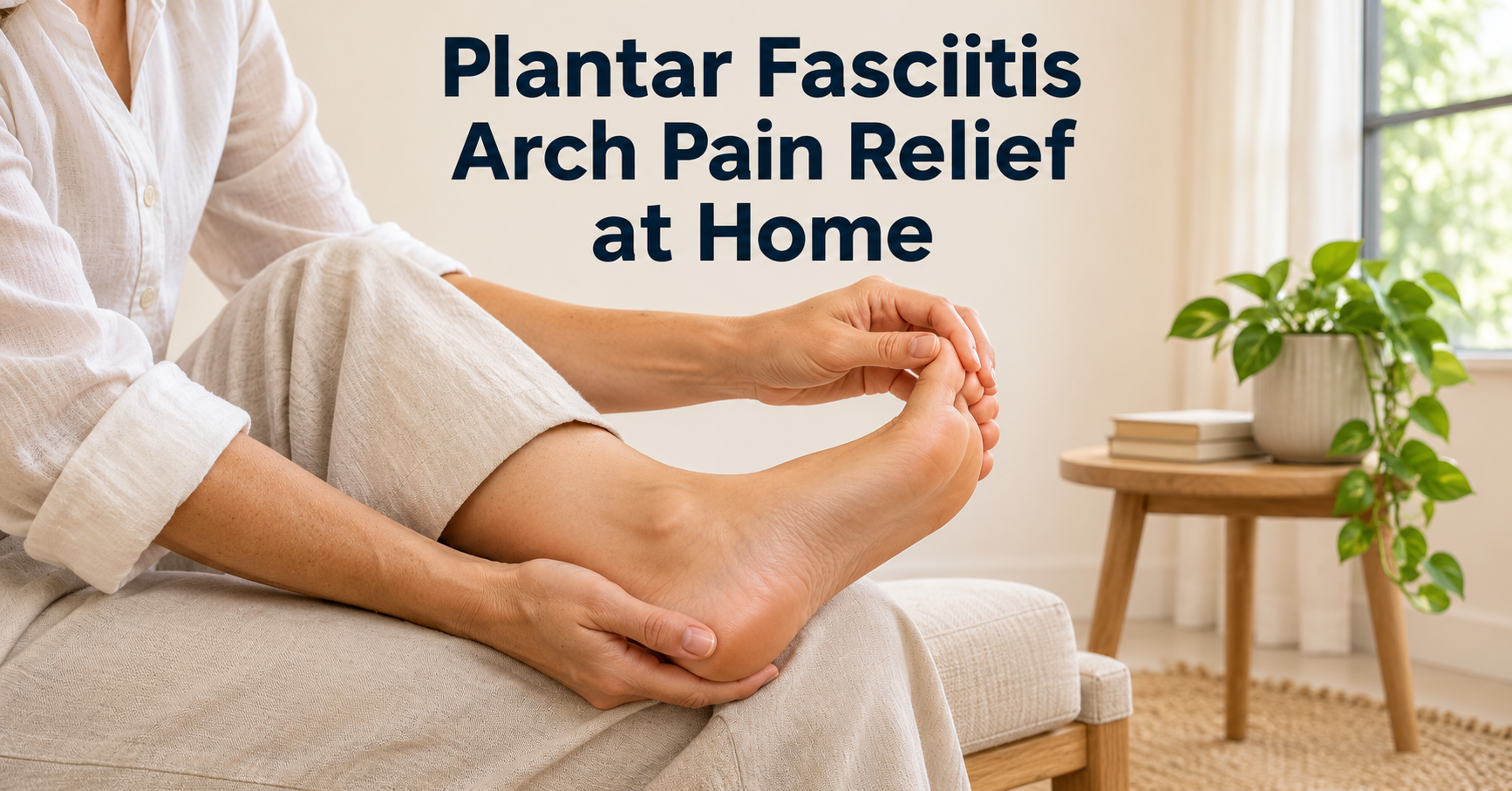

That stabbing pain under your foot with your very first steps in the morning. The ache along the arch that builds as the day goes on. The way it eases as you warm up and then returns after you sit for a while. If this sounds like your daily experience, you may be dealing with plantar fasciitis, the most common cause of heel and arch pain in adults.
The encouraging news is that most people improve with consistent care at home. You do not need expensive treatments to get started. In this complete guide you will learn what plantar fasciitis is, how to recognize it, and exactly how to build a home relief plan with stretches, strengthening, footwear changes, and smart daily habits. You will also learn what to avoid, how long recovery usually takes, and when it is time to see a doctor.
Quick Answer
The best plantar fasciitis arch pain relief at home combines four things: daily stretching of the plantar fascia and calves, supportive and cushioned footwear (including at home), load management so you stop re-irritating the tissue, and progressive strengthening of the calf and foot muscles. Ice, massage with a ball, taping, and a night splint can add comfort. Most people feel better within weeks and recover over a few months. See a doctor if the pain is severe, has a sudden onset with a pop, comes with numbness or swelling, or does not improve after two to three weeks.
Table of Contents
- What Is Plantar Fasciitis?
- Symptoms: How Plantar Fasciitis Arch Pain Feels
- What Causes Plantar Fasciitis?
- Do You Have Plantar Fasciitis? Self-Check
- When to See a Doctor Instead
- Home Relief: The Complete Plan
- Step-by-Step Stretches
- Strengthening Exercises
- Footwear, Insoles and Gear
- What to Avoid
- A Typical Recovery Timeline
- Medical Treatments If Home Care Is Not Enough
- Daily Habits and Prevention
- Frequently Asked Questions
What Is Plantar Fasciitis?
The plantar fascia is a thick, strong band of tissue that runs along the bottom of your foot from the heel bone to the base of the toes. It supports the arch and acts like a spring, absorbing shock every time your foot lands and helping you push off when you walk or run.
Plantar fasciitis is a painful condition of this tissue, typically at the point where it attaches to the heel bone. Although the name suggests inflammation, current thinking is that it is often a degenerative, overload-related irritation of the fascia. The pain is usually felt at the heel and may spread into the arch, which is why many people describe it as arch pain.

Symptoms: How Plantar Fasciitis Arch Pain Feels
Typical signs include:
- Sharp, stabbing pain at the heel or along the arch with the first steps after waking up
- Pain after sitting for a while, such as after a long drive or desk work
- Pain that eases after a few minutes of walking but may return later in the day
- Soreness after exercise, rather than during it, in the early stage
- Tenderness when you press on the inner side of the heel or along the arch
- Tightness in the calf and the back of the ankle
- Pain that gets worse when you climb stairs, stand on tiptoe, or walk barefoot on hard floors
The pattern is often the clue. If your pain is sharpest with the first steps and after rest, plantar fasciitis is a strong possibility.
What Causes Plantar Fasciitis?
Plantar fasciitis develops when the fascia is repeatedly loaded more than it can tolerate. Several factors often combine.

1. Sudden increase in activity
Starting a running program, walking much more than usual, or adding hill work or speed too quickly can overload the fascia.
2. Tight calves and Achilles tendon
A stiff ankle forces the foot to work harder, increasing tension through the plantar fascia.
3. Foot structure
Flat feet, high arches, or abnormal walking mechanics change how force travels through the foot.
4. Unsupportive or worn-out shoes
Thin soles, no arch contour, and worn cushioning mean the fascia takes more of the impact.
5. Prolonged standing or hard surfaces
Jobs that keep you on your feet on concrete or tile are a classic risk factor.
6. Body weight
Extra weight increases the load through the foot with every step.
7. Age and tissue changes
The condition is most common between 40 and 60, when fascia and the heel fat pad become less resilient.
8. Weak foot and calf muscles
When the supporting muscles are weak, more of the work falls on the fascia.
Do You Have Plantar Fasciitis? Self-Check
This quick checklist can help you decide whether your symptoms fit. It is not a diagnosis.
- Is the pain worst with your first steps in the morning or after sitting?
- Is the pain at the heel or along the inner arch, and tender when you press there?
- Does it ease after a few minutes of walking?
- Did it build gradually rather than start with a single injury?
- Is your calf tight, or do you stand or exercise a lot on hard surfaces?
- Do you have a recent change in shoes, activity, or weight?
If you answered yes to most of these, plantar fasciitis is likely, and a home program is a sensible first step. Other conditions can feel similar, including heel pad irritation, nerve entrapment, stress fractures, and tendon problems, which is why the warning signs below matter.
When to See a Doctor Instead
Get medical advice if you notice:
- Sudden severe pain, a pop or tearing sensation, or bruising and swelling
- Inability to put weight on the foot
- Numbness, tingling, or burning
- Pain at night or at rest that does not ease
- Redness, warmth, or fever
- Diabetes, poor circulation, or neuropathy with any new foot pain
- No improvement after two to three weeks of consistent home care
- Pain that keeps getting worse

Home Relief: The Complete Plan
Consistency matters more than any single technique. Combine these methods into a daily routine.

1. Reduce the Load, Do Not Stop Moving
Cut back on high-impact activity such as running, jumping, and long stretches of standing, but keep moving gently. Swap in swimming, cycling, or walking on soft surfaces. Total rest is rarely the answer, because the fascia needs controlled loading to heal.
2. Stretch the Plantar Fascia and Calves Daily
Stretching is one of the best-supported home treatments. Do it first thing in the morning before your feet touch the floor, and again several times during the day. The step-by-step stretches are below.
3. Roll and Massage the Arch
Roll a golf ball, massage ball, or a frozen water bottle under your arch for two to three minutes, using moderate pressure. This can reduce tightness and provide temporary relief. It should feel like a firm massage, not sharp pain.
4. Use Cold Therapy
A cold pack wrapped in a thin towel for 10 to 15 minutes after activity or at the end of the day can ease soreness. A frozen bottle combines cold and rolling.
5. Wear Supportive Footwear All Day
Do not walk barefoot on hard floors, even at home. Choose cushioned, supportive shoes or slippers with a contoured footbed and put them on as soon as you get out of bed.
6. Try Taping or a Night Splint
Supportive taping can reduce strain on the fascia for a few hours. A night splint holds the foot in a gently stretched position during sleep and can reduce first-step pain for some people.
7. Consider Safe Pain Relief
Short-term over-the-counter pain relief may help some people when used according to the label. Check with a pharmacist or doctor if you have other conditions or take other medicines.
8. Manage Body Weight and Daily Load
If excess weight is a factor, even modest weight loss can reduce load on the fascia. Pace your day, take sitting breaks, and avoid long periods on hard surfaces.
Step-by-Step Stretches
Perform these once or twice daily. Mild stretching discomfort is normal, but stop if the pain becomes sharp.
1. Morning Plantar Fascia Stretch (Before You Stand)
Sit on the edge of the bed, cross the sore foot over the opposite knee, and pull your toes back toward your shin until you feel a stretch along the arch. Press your thumb along the arch to feel the tension. Hold 10 to 30 seconds and repeat three times.
2. Towel or Strap Stretch
Sit with your leg straight, loop a towel or strap around the ball of the foot, and gently pull it toward you, keeping the knee straight. Hold 30 seconds, three times.
3. Wall Calf Stretch (Straight Knee)
Face a wall, put the sore leg straight behind you with the heel down, and lean forward until you feel a stretch in the upper calf. Hold 30 seconds, three times.
4. Wall Calf Stretch (Bent Knee)
In the same position, bend the back knee slightly while keeping the heel down to stretch the deeper soleus muscle. Hold 30 seconds, three times.
5. Step Stretch
Stand on the edge of a step with the heels hanging off, holding a rail. Lower the heels slowly until you feel a stretch in the calf and arch. Hold 20 to 30 seconds and repeat three times. Keep it gentle and skip it if it causes sharp pain.
Strengthening Exercises
Strengthening helps the foot and calf share the load. Add these once the sharp pain has settled enough that walking is mostly comfortable, and progress gradually.
1. High-Load Calf Raises with a Towel Roll
Place a rolled towel under your toes so they are bent upward, then rise onto the ball of the foot, pause, and lower slowly. A common pattern is three seconds up, a short hold, and three seconds down. Start with two to three sets of 8 to 12 repetitions every other day and progress under guidance. This exercise places controlled load on the fascia.
2. Short-Foot Exercise
Draw the ball of the foot toward the heel to raise the arch without curling the toes. Hold five seconds and repeat ten times.
3. Towel Scrunches
Use your toes to scrunch a small towel toward you. Do two sets of 15.
4. Toe Spreading and Toe Yoga
Lift the big toe while pressing the other toes down, then reverse. This improves foot control. Do ten repetitions each way.
5. Single-Leg Balance
Stand on one foot for 30 to 60 seconds with the arch lifted. Stand on a folded towel to make it harder.
6. Hip Strengthening
Glute bridges, clamshells, and side-lying leg raises, two to three sets of 10 to 15, improve leg alignment and reduce stress on the foot.
Footwear, Insoles and Gear
The right footwear is one of the most practical parts of a home plan. When choosing shoes, look for:
- Good cushioning, especially under the heel
- A contoured arch and firm midsole that does not twist easily
- A firm heel counter and a roomy toe box
- A sole that bends at the ball of the foot, not in the middle
- A removable insole so you can add a support if needed
Replace worn shoes, and rotate between pairs. Here are categories of products many people consider, along with what to look for.
Arch-Support Insoles
Best for: flat or low arches and all-day standing or walking.
What to look for: a contoured but not rock-hard shape, a deep heel cup, and the right arch height for your foot. Remove the factory insole first and break in gradually.
Cushioned Heel Cups or Gel Heel Pads
Best for: heel-focused pain and high arches that need shock absorption.
What to look for: resilient, shock-absorbing material that does not flatten quickly and fits well inside your shoe.
Supportive Walking or Athletic Shoes
Best for: daily wear and exercise.
What to look for: cushioning, a stable sole, a firm heel counter, and a roomy toe box. Try them on in the afternoon with your usual socks.
Supportive Slippers or Recovery Slides
Best for: protecting your feet at home, especially in the morning.
What to look for: a contoured footbed, a cushioned heel, and an easy slip-on design that stays on your foot.
Plantar Fasciitis Night Splint
Best for: severe first-step morning pain.
What to look for: adjustable straps, breathable padding, a comfortable angle, and a design you can sleep in. Ask a doctor or podiatrist if you are unsure.
Massage Ball or Foot Roller
Best for: daily self-massage of a tight arch.
What to look for: a firm but not rock-hard surface and a comfortable size; some are freezer-friendly for cold therapy.
Stretching Strap or Plantar Fascia Stretcher
Best for: consistent calf and fascia stretching.
What to look for: a durable strap, a non-slip surface, and a design that is comfortable to hold.
Kinesiology Tape or Arch Support Tape
Best for: short-term support during the day.
What to look for: skin-friendly adhesive, enough stretch and strength, and a method taught by a professional or a trusted guide.
Compression Arch Sleeves
Best for: mild swelling and a supported feeling.
What to look for: graduated compression, a seamless design, and a snug but not tight fit.
Gear helps your plan, but it does not replace stretching, strengthening, and managing your daily load.
What to Avoid
- Walking barefoot on hard floors, especially first thing in the morning
- Wearing worn-out, flat, or flimsy footwear such as thin flip-flops
- Pushing through sharp pain with high-impact exercise
- Aggressive deep massage or very hard rolling that makes the foot more sore
- Stopping stretching as soon as you feel a little better
- Going back to full activity too fast
- Relying on repeated self-treatment with strong medication instead of getting a proper assessment
A Typical Recovery Timeline
Plantar fasciitis can be stubborn, but the outlook is good. Many people notice improvement within a few weeks of consistent care, and most recover substantially over several months. A small number need a year or more. The graphic below shows a general pattern. Your own pace may be faster or slower.

Flare-ups are common if you return to heavy activity too quickly. If you hit a setback, go back a step, keep stretching, and increase activity more slowly.
Medical Treatments If Home Care Is Not Enough
If you have followed a sensible home plan for several weeks without improvement, a healthcare professional can offer other options, such as:
- Physical therapy: guided stretching, strengthening, manual therapy, and gait retraining
- Custom orthotics: shaped to your foot and walking pattern
- Imaging: ultrasound or MRI to confirm the diagnosis or rule out other causes
- Shockwave therapy: used for some stubborn cases
- Injections: considered with caution and only under medical supervision
- Boot or cast: a short period of immobilization for severe cases
- Surgery: rarely needed, and only after other treatments have failed
Daily Habits and Prevention
- Stretch your calves and plantar fascia every morning and after long periods of sitting
- Put on supportive footwear as soon as you get out of bed
- Replace running and walking shoes before they wear out
- Increase running, walking, and standing time gradually
- Strengthen the calves, feet, and hips regularly
- Use cushioned mats or insoles if you stand on hard floors at work
- Maintain a healthy body weight
- Vary your surfaces and activities, and include rest days
- Do not ignore early heel or arch soreness
Frequently Asked Questions
How long does plantar fasciitis take to heal at home?
Mild cases can improve within a few weeks, but many people need two to six months of consistent care, and some take longer. Staying consistent with stretching, supportive footwear, and load management gives the best chance of full recovery.
What is the fastest way to relieve plantar fasciitis pain at home?
There is no instant cure, but the quickest relief usually comes from combining morning stretches, supportive shoes, cold or rolling for soreness, and temporarily reducing impact activities. A night splint helps some people with first-step pain.
Is walking good for plantar fasciitis?
Gentle walking in supportive shoes is usually fine and can help. Avoid long walks on hard surfaces or in unsupportive footwear if they increase your pain, and build up gradually.
Should I use ice or heat for plantar fasciitis?
Cold is helpful for soreness after activity. Some people find gentle warmth before stretching more comfortable. Use whichever settles your symptoms, and avoid heat on swollen or numb feet.
Does stretching really help plantar fasciitis?
Yes. Plantar fascia and calf stretching are among the most commonly recommended home treatments and are supported by research when done consistently.
Can I run with plantar fasciitis?
Mild cases may allow reduced running with good footwear and careful load management, but if the pain is increasing or changes your stride, take a break from running and cross-train until it settles.
Are insoles worth it for plantar fasciitis?
Many people find that arch-support insoles or heel cushions reduce pain, particularly with flat feet or long hours standing. They work best together with stretching and strengthening.
Can plantar fasciitis go away on its own?
Some cases improve over time, but without addressing the causes it often lingers or returns. A proactive home plan usually speeds recovery.
Final Thoughts
Plantar fasciitis arch pain can be frustrating, especially when it greets you with every first step of the day. But it is one of the most treatable foot conditions, and most of the work can be done at home. Stretch daily, wear supportive shoes, manage your load, strengthen your feet and calves, and be patient. Progress often comes gradually, then suddenly feels noticeable.
Start tomorrow morning: stretch your foot and calf before you stand, slip on supportive footwear, and keep up the routine for the next few weeks. If your pain is severe, unusual, or not improving, get professional advice. A proper assessment can set you on the right path faster.
Medical disclaimer: This article is for general information only and is not a substitute for professional medical advice, diagnosis, or treatment. Always consult a qualified healthcare professional about foot pain or before starting a new exercise program.
Affiliate disclosure: Some product categories mentioned in this guide may include affiliate links in the future. If you buy through them, this site may earn a small commission at no extra cost to you. Our recommendations are based on what is most useful for readers.