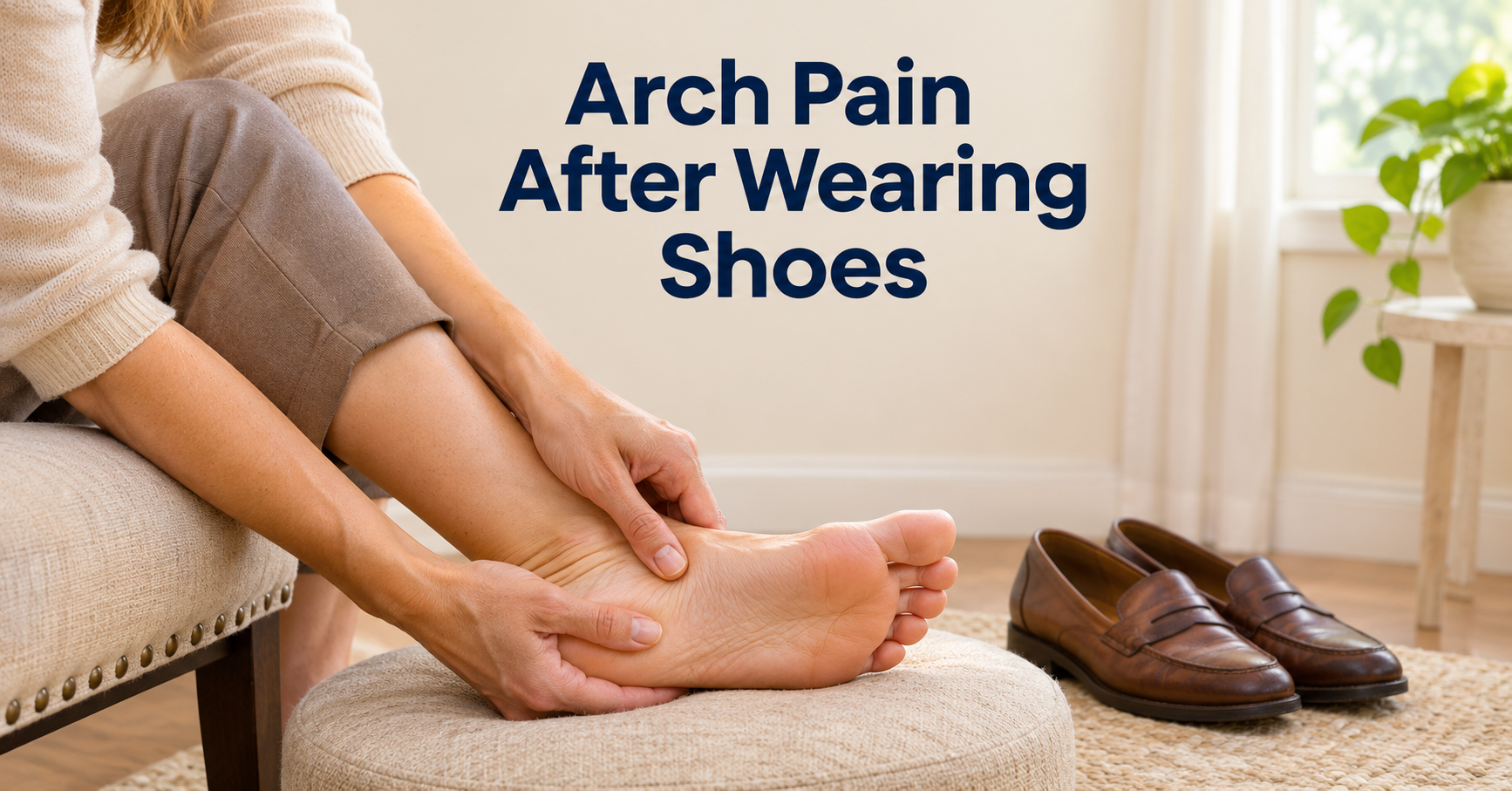

You slip on a pair of shoes in the morning, and by lunchtime the inside of your foot is aching. Maybe it is a dull soreness along the arch, maybe a sharp pull that gets worse the longer you stand. Take the shoes off and it eases, but put them on again and the pain returns. If this sounds familiar, you are dealing with arch pain after wearing shoes, a problem that affects people who walk, stand, or work on their feet all day.
The reassuring part is that shoes are one of the easiest causes to fix. In this complete guide you will learn why your arch hurts after wearing shoes, which footwear is the worst offender, how to check whether your feet or your shoes are to blame, how to get relief today, which stretches help, how to choose shoes that fit properly, and how to break in new pairs without suffering.
Quick Answer
Arch pain after wearing shoes usually happens when your footwear does not match your foot: not enough or too much arch support, a narrow or short fit, stiff or worn-out soles, or a high heel. It can also flare up an existing problem such as plantar fasciitis or flat feet. Switch to roomy, cushioned, supportive shoes, check or replace the insoles, stretch your calves and arches, and break new shoes in gradually. See a doctor if the pain is severe, constant, or lasts more than two to three weeks.
Table of Contents
- What Is Arch Pain After Wearing Shoes?
- Symptoms to Look For
- Why Your Arch Hurts After Wearing Shoes
- Which Shoes Are Most Likely to Hurt Your Arch?
- Is It the Shoes or Your Feet? Check Your Arch Type
- When to See a Doctor
- Quick Relief: What to Do Today
- Stretches and Exercises
- How to Choose Shoes That Don’t Hurt Your Arch
- Insoles, Arch Supports and Comfort Gear
- How to Break In New Shoes Safely
- Prevention Checklist
- Frequently Asked Questions
What Is Arch Pain After Wearing Shoes?
The arch of your foot is a natural spring. It flattens a little with each step to absorb shock and then springs back to push you forward. The plantar fascia, a thick band of tissue running from the heel to the toes, acts like a bowstring beneath it, while tendons such as the posterior tibial tendon help hold the arch up.
Shoes change how this system works. A good shoe supports the foot, spreads pressure evenly, and flexes where your foot flexes. A bad shoe does the opposite: it can leave the arch unsupported, squeeze it, tilt it, or force it to work harder than it should. Over hours of standing and walking, that extra stress turns into inflammation and pain.

Symptoms to Look For
Arch pain linked to footwear can show up in several ways:
- A dull ache or burning along the inside of the foot after a few hours in shoes
- Sharp or pulling pain that gets worse the longer you stand or walk
- Pain that eases when you take the shoes off but returns when you put them on
- A cramping, tired feeling in the arch by the end of the day
- Pain that starts right after you wear a new pair
- Soreness or tenderness when you press on the arch or the area near the heel
- First-step pain in the morning, which can signal plantar fasciitis
- Mild swelling or redness along the inside of the foot
Notice the pattern. If the pain appears only in certain shoes, the footwear is very likely a trigger. If it hurts in every shoe, and even barefoot, an underlying foot problem is more probable.
Why Your Arch Hurts After Wearing Shoes
Shoe-related arch pain rarely comes from a single factor. Here are the most common causes.

1. Not Enough Arch Support
Flat, thin-soled shoes such as ballet flats, many sandals, and cheap sneakers offer almost no support. Without it, the arch flattens more than it should, and the plantar fascia is stretched with every step. This is especially painful for people with naturally flat or low arches.
2. Too Much or Poorly Placed Arch Support
More support is not always better. A hard, high insert or a built-in arch bump in the wrong spot can press into the arch, causing aching and soreness. This often explains why a brand-new pair hurts even though the shoe is described as ‘supportive’.
3. Shoes That Are Too Narrow or Too Short
A cramped fit squeezes the midfoot and toes. It stops your foot from spreading naturally when you stand, and forces the arch muscles and fascia to work against pressure. Pointed-toe shoes are a classic example.
4. Stiff Soles or Soles That Do Not Flex Properly
A shoe should bend at the ball of the foot. If it is rigid, or bends in the middle of the arch instead, the arch takes the strain. Very stiff dress shoes and shoes that fold in half are common culprits.
5. Worn-Out Shoes
Foam compresses and soles wear unevenly over time. A worn shoe loses cushioning and stability, so impact goes straight into your arch. Check the sole and midsole for creasing, flattened areas, or a heel that has worn down on one side.
6. High Heels and a Steep Heel-to-Toe Drop
Heels push your weight forward and shorten the calf muscles. Tight calves pull on the plantar fascia, and the arch is forced into an unnatural shape. Even a modest heel can contribute if you wear it all day.
7. Completely Flat Shoes and Flip-Flops
It may surprise you, but ultra-flat shoes with no contour can be just as hard on the arch. Walking in flip-flops also makes your toes grip to keep them on, which strains the foot.
8. Existing Foot Conditions
Plantar fasciitis, flat feet, high arches, posterior tibial tendon problems, bunions, and tight Achilles tendons all make your arch more sensitive to shoe choice. In these cases the shoe does not create the problem, it reveals it.
9. Long Hours on Hard Surfaces
Standing for long periods on concrete or tile in unsuitable shoes overloads the arch. Teachers, nurses, retail workers, factory workers, and hospitality staff are especially affected.
10. Sudden Changes in Footwear
Switching from a cushioned shoe to a minimalist one, or from sneakers to a stiff boot, forces your feet to adapt overnight. A new pair worn all day without a break-in period can cause soreness within hours.
Which Shoes Are Most Likely to Hurt Your Arch?
Almost any shoe can cause trouble if the fit is wrong, but some styles are more likely to cause arch pain than others:
| Shoe type | Why it can hurt | Better choice |
|---|---|---|
| High heels | Forward weight shift, tight calves, pressure on the ball and arch | Low block heel with a cushioned insole |
| Ballet flats | Thin, flat, no arch contour | Flats with a contoured footbed |
| Flip-flops | No support, toes grip to hold on | Sandals with arch support and a heel strap |
| Stiff dress shoes | Rigid sole, poor flex, thin insole | Flexible leather shoes with a cushioned footbed |
| Pointed-toe shoes | Squeezes toes and midfoot | Almond or round toe with room to spread |
| Old or cheap sneakers | Collapsed cushioning, little support | Supportive walking or cushioned athletic shoes |
| Work boots | Heavy, stiff, often thin insoles | Boots with shock-absorbing insoles and good flex |
Is It the Shoes or Your Feet? Check Your Arch Type
Knowing your arch type helps you choose better footwear. Try the wet test: wet the bottom of your foot, step onto a dark piece of paper or dry concrete, and look at the footprint.

A nearly full footprint suggests a flat or low arch, which usually needs structured support and a stable shoe. A clear curve suggests a normal arch. A very thin or missing band suggests a high arch, which usually needs good cushioning and a flexible, accommodating shoe. This test is only a rough guide. A foot specialist can assess your arch, gait, and alignment much more accurately.
A simple experiment can also help: if your arch pain disappears in one pair of shoes but returns in another, the difference between those two pairs is your biggest clue.
When to See a Doctor
Get medical advice if you notice:
- Severe pain, or being unable to put weight on your foot
- Swelling, bruising, redness, or warmth that does not settle
- Numbness, tingling, or burning in the foot
- Pain at night or while resting
- A noticeable change in the shape of your arch or ankle
- No improvement after two to three weeks of sensible self-care
- Diabetes, poor circulation, or neuropathy
A doctor or podiatrist can find out whether you have plantar fasciitis, a tendon problem, a stress injury, or nerve irritation, and recommend treatment such as physical therapy or custom orthotics.
Quick Relief: What to Do Today
If your arch is sore right now, try these steps:
- Take off the offending shoes. Switch to a soft, cushioned, supportive pair and avoid walking barefoot on hard floors.
- Rest and elevate. Sit down, raise your feet, and take the load off for a while.
- Apply ice. Use a cold pack wrapped in a thin towel for 10 to 15 minutes, or roll your arch over a frozen water bottle.
- Stretch gently. Use the calf and plantar fascia stretches below.
- Massage your arch. Roll a golf ball or massage ball under the foot for two to three minutes.
- Consider pain relief only if it is safe for you and follow the label. Ask a pharmacist or doctor if you are unsure.

Stretches and Exercises
Stretching and strengthening help your arch cope better with whatever shoes you wear. Do these once or twice a day. Mild stretching discomfort is fine, but stop if the pain becomes sharp.
1. Plantar Fascia Stretch
Sit and cross the sore foot over your opposite knee. Pull your toes back gently toward your shin until you feel a stretch along the arch. Hold for 30 seconds and repeat three times.
2. Calf Wall Stretch
Stand facing a wall, keep the sore leg straight behind you with the heel down, and lean forward. Hold for 30 seconds, three times. Repeat with a slightly bent knee to target the deeper calf muscle.
3. Ball Roll
Roll a golf ball or massage ball from heel to forefoot under the arch for two to three minutes. Keep the pressure moderate.
4. Towel Scrunches
Place a small towel on the floor and use your toes to scrunch it toward you. Do two sets of 15.
5. Short-Foot Exercise
Draw the ball of your foot toward your heel to lift the arch without curling the toes. Hold five seconds and repeat ten times.
6. Calf Raises
Rise slowly onto your toes, pause, then lower over three to four seconds. Do three sets of 12 when walking is mostly comfortable.
7. Toe Spreading
Sit with your foot flat and spread your toes as wide as you can, hold for five seconds, and relax. This reactivates foot muscles that are squeezed by narrow shoes.
How to Choose Shoes That Don’t Hurt Your Arch
The right shoe is the single biggest change most people can make. Use this checklist when you shop.

- Shop in the afternoon or evening when your feet are at their largest.
- Measure both feet. Most people have one slightly larger foot, so fit the larger one.
- Leave about a thumb’s width between your longest toe and the end of the shoe.
- Choose a wide enough toe box so your toes can spread without rubbing or squeezing.
- Test the heel. It should feel firmly held without slipping or pinching.
- Check where the shoe bends. Hold the heel and toe and flex it. It should bend at the ball of the foot, not at the arch.
- Try the shoe with the socks you normally wear and any orthotic or insole you use.
- Feel the arch contour. Support should touch your arch comfortably. If it pokes, presses, or feels like a lump, the shape does not suit your foot.
- Walk around the store on a hard surface for several minutes. Comfort should be immediate. Do not rely on the idea that shoes will “stretch out” and become comfortable later.
- Choose moderate cushioning and a stable sole for all-day wear.
- Keep heels modest. If you wear heels, choose a lower, wider heel and alternate with flatter supportive shoes.
- Replace shoes before they collapse. Everyday shoes worn daily often need replacing within about 6 to 12 months, and athletic shoes after about 300 to 500 miles of use.
Rotating between two or three pairs of shoes is another good habit. It gives the cushioning time to recover and varies the way pressure falls on your feet.
Insoles, Arch Supports and Comfort Gear
Supportive accessories can make a big difference when chosen correctly. Here is what to look for in each category and who it suits best.
Cushioned Arch-Support Insoles
Best for: flat or low arches, long hours on your feet, and shoes with thin factory insoles.
What to look for: a contoured but not overly hard shape, a deep heel cup, and the right arch height for your foot. Remove the shoe’s original insole first, and introduce new insoles gradually over several days.
Gel or Memory-Foam Cushioning Insoles
Best for: high arches and people who need shock absorption more than correction.
What to look for: soft but resilient material that does not flatten quickly, and a shape that does not make the shoe too tight.
Supportive Walking or Work Shoes
Best for: teachers, nurses, retail and hospitality workers, and anyone on their feet all day.
What to look for: a roomy toe box, a firm heel counter, good cushioning, a slip-resistant sole if needed, and a removable insole.
Orthopedic or Supportive Sandals
Best for: summer wear and home use for people who find flip-flops painful.
What to look for: a contoured footbed, a cushioned heel, adjustable straps, and a sole that does not fold in half.
Massage Ball or Foot Roller
Best for: daily self-massage of a tight arch.
What to look for: a firm but not rock-hard surface, and a size comfortable under the foot. A rollable bottle or a freezer-friendly roller adds cold therapy.
Compression Arch Sleeves
Best for: mild soreness and swelling at the end of the day.
What to look for: graduated compression, a seamless design, and a snug but not tight fit. They give light support but do not replace good shoes.
Plantar Fasciitis Night Splint or Stretching Strap
Best for: morning first-step pain.
What to look for: adjustable straps, breathable padding, and a design you can sleep in or use comfortably during the day.
Heel Cups and Heel Pads
Best for: heel and rear-arch discomfort and mild heel impact pain.
What to look for: shock-absorbing material, a good fit inside your shoe, and a profile that does not push your heel out.
No product is a magic cure. Combine the right shoes and insoles with stretching, strengthening, and sensible footwear habits for the best results.
How to Break In New Shoes Safely
Many cases of arch pain start the first week after buying new shoes. A gradual break-in protects your feet:
- Wear new shoes at home for 30 to 60 minutes on day one.
- Increase wear time by an hour or so each day, if there is no arch discomfort.
- Alternate new shoes with an old comfortable pair during the first week.
- Swap in a better insole right away if the factory one is thin or lumpy.
- Avoid wearing brand-new shoes for long walks, a full shift, or travel.
- If pain appears and does not fade as the shoes soften, return them if possible, since a poor shape rarely improves with time.
Prevention Checklist
- Choose shoes that suit your arch type and foot shape, not just your size number
- Replace worn shoes and insoles on time
- Alternate between pairs and avoid wearing the same shoes every day
- Limit high heels and ultra-flat footwear for long periods
- Stretch your calves and arches daily, and do foot-strengthening exercises a few times a week
- Take short breaks to sit and relax your feet during long shifts
- Use cushioned mats or soft flooring if you stand on hard surfaces
- Maintain a healthy body weight to reduce load on the arches
- Do not ignore early arch soreness, since small problems are easier to fix
Frequently Asked Questions
Why does my arch hurt only when I wear certain shoes?
Each shoe has a different shape, sole, heel height, and insole. If a particular pair lacks the support your arch needs, squeezes your foot, or has a hard spot under the arch, it can trigger pain even if other shoes are fine.
Why does my arch hurt after wearing new shoes?
New shoes may be stiff, have a different arch contour from what your feet are used to, or simply not fit well. A short break-in period helps when the shape is right, but shoes that hurt from day one are often the wrong match.
Can flat shoes cause arch pain?
Yes. Completely flat shoes with thin soles and no arch contour allow the arch to collapse and strain the plantar fascia, especially if you stand or walk for long periods.
Can high heels cause arch pain?
Yes. Heels shift your weight forward, shorten your calf muscles, and place stress on the ball of the foot and arch. Wearing them occasionally is usually fine, but all-day wear can cause pain.
How long does arch pain from shoes last?
If you fix the cause, mild irritation often settles within days to a couple of weeks. Plantar fasciitis or tendon problems can take longer. If the pain continues for more than two to three weeks, see a professional.
Are arch supports good for sore arches?
They can be, particularly for flat or low arches. The key is the right shape and height for your foot. If a support feels hard or pokes into your arch, try a different type or ask a specialist.
Is it normal for shoes to hurt my arch until they are broken in?
Mild snugness can be normal for a short time, but sharp or persistent arch pain is not. Shoes should feel comfortable almost immediately.
Should I walk barefoot to strengthen my arches?
Gradual barefoot walking on soft, safe surfaces can strengthen your feet over time, but going barefoot on hard floors can make a sore arch worse. Introduce it slowly and only once the pain has settled.
Final Thoughts
Arch pain after wearing shoes is frustrating, but it is usually a sign that something about your footwear, your feet, or both needs attention. Look at the pattern of your pain, choose shoes with the right fit and support, keep your calves and arches flexible and strong, and give new shoes time to earn their place in your rotation.
Tonight, take five minutes to stretch your calves and arches, check the insoles and soles of the shoes you wear most often, and set aside any pair that consistently leaves your arch aching. Your feet carry you through every day, so they deserve shoes that work with them.
Medical disclaimer: This article is for general information only and is not a substitute for professional medical advice, diagnosis, or treatment. Always consult a qualified healthcare professional about foot pain or before starting a new exercise program.
Affiliate disclosure: Some product categories mentioned in this guide may include affiliate links in the future. If you buy through them, this site may earn a small commission at no extra cost to you. Our recommendations are based on what is most useful for readers.