


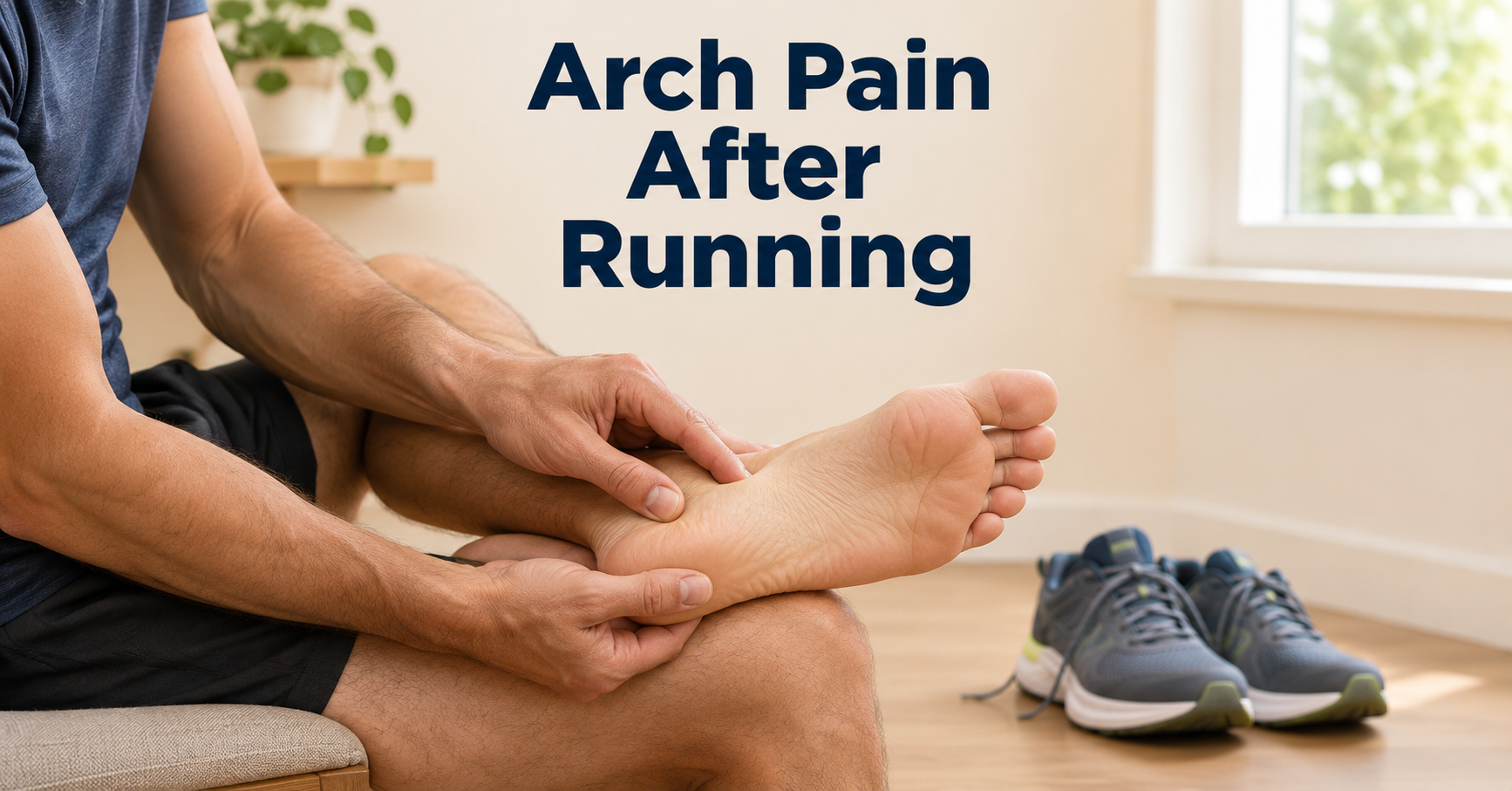

You finish a good run, sit down, and then it hits you: a deep, nagging ache along the inside of your foot. By the time you stand up, every step feels stiff and sore. If that sounds familiar, you are dealing with arch pain after running, one of the most common complaints among runners of every level.
The good news is that most cases are treatable at home when you understand what is causing them. In this complete guide you will learn what is happening inside your foot, the most common causes, how to get relief in the first 48 hours, the stretches and exercises that actually help, how to choose the right shoes and support, and how to return to running without the pain coming back.
Quick Answer
Arch pain after running usually comes from overloaded tissue under the foot, most often the plantar fascia, combined with worn shoes, a sudden jump in mileage, tight calves, or an arch that collapses or is too rigid. Rest from hard running for a few days, ice and gently stretch the foot, strengthen the arch, wear supportive footwear, and return to running gradually. See a doctor if the pain is severe, you cannot bear weight, or it lasts more than two to three weeks.
Table of Contents
- What Is Arch Pain and How Does the Foot Arch Work?
- Symptoms: What Arch Pain After Running Feels Like
- Common Causes of Arch Pain After Running
- Check Your Arch Type: The Wet Test
- When to See a Doctor
- Quick Relief: What to Do in the First 48 Hours
- Best Stretches and Exercises for Arch Pain
- How to Choose Running Shoes for Arch Pain
- Arch Supports and Recovery Gear Worth Considering
- How to Return to Running Safely
- Prevention Checklist
- Frequently Asked Questions
What Is Arch Pain and How Does the Foot Arch Work?
Your foot has a natural curve on the inner side called the medial longitudinal arch. It works like a spring. Each time your foot lands, the arch flattens slightly to absorb shock, then recoils to push you forward. Several structures share this job:
- Plantar fascia: a thick band of tissue running from your heel bone to the base of your toes. It acts like the string of a bow, holding the arch up.
- Posterior tibial tendon: runs along the inside of the ankle and supports the arch during push-off.
- Small foot muscles: the intrinsic muscles that quietly control arch height with every step.
- Bones and ligaments: provide the framework that holds everything together.
When running places more stress on these structures than they can handle, they become irritated or inflamed. That is arch pain. A runner can take well over a thousand foot strikes per mile, so even a small mechanical problem multiplies quickly.

Symptoms: What Arch Pain After Running Feels Like
Arch pain can feel different depending on the cause, but runners commonly report:
- A dull ache or burning sensation along the inside of the foot after a run
- Sharp or stabbing pain when you take your first steps in the morning
- Pain that eases as you warm up but returns once you stop and rest
- Tenderness when you press on the arch or just in front of the heel
- Tightness or a pulling feeling that extends toward the heel or the inner ankle
- Mild swelling along the inside of the foot or ankle
- A feeling that the arch is tired, flat, or “giving way”
Pay attention to when it hurts. Pain that is worst with the first steps after sitting or sleeping points toward plantar fasciitis. Pain on the inner ankle with a sagging arch may point toward the posterior tibial tendon. Pain at one precise point that gets worse during each run could be a stress injury, which needs professional evaluation.
Common Causes of Arch Pain After Running
Arch pain rarely has a single cause. It is usually a mix of training, footwear, and foot mechanics. Here are the main culprits.

1. Plantar Fasciitis
This is the most common cause. Repeated stress creates tiny tears and irritation where the fascia attaches near the heel, and the pain often spreads into the arch. It is classically worst with the first steps of the day and after long periods of sitting.
2. Increasing Mileage or Intensity Too Quickly
Bones, tendons, and fascia adapt more slowly than your lungs and leg muscles. Jumping your weekly distance, adding hill repeats, or starting speed work too soon can overload the arch before it is ready. A common guideline is to increase weekly volume gradually, by roughly 10 percent or less, and to avoid changing several variables in the same week.
3. Worn-Out or Unsuitable Running Shoes
Foam midsoles compress and lose their ability to absorb shock. Most running shoes last roughly 300 to 500 miles (about 500 to 800 km), depending on your weight, running surface, and the shoe itself. Wearing shoes that are too flat, too stiff, too narrow, or simply the wrong shape for your foot can also trigger arch pain.
4. Flat Feet and Overpronation
If your arch flattens a lot on landing, the plantar fascia and posterior tibial tendon work overtime to control the movement. Over many miles that extra strain becomes pain. Not everyone with flat feet has problems, but runners with flat feet are more prone to arch irritation when training load rises.
5. Tight Calves and Achilles Tendon
The calf muscles and the plantar fascia are mechanically connected. When your calves and Achilles are tight, your ankle cannot bend as far as it should, and the foot makes up for it by pulling harder on the fascia. Many runners with chronic arch pain discover that stretching their foot alone is not enough until the calves are addressed too.
6. High Arches and Rigid Feet
A high arch does not flatten much, so it absorbs less shock. Impact is transferred into the heel, the ball of the foot, and the fascia. Runners with high arches often benefit from extra cushioning rather than rigid stability features.
7. Weak Foot and Hip Muscles
Small intrinsic foot muscles and the stabilizing muscles around the hip help control how your foot lands. When they are weak or tired, the arch takes more of the load. This is why strengthening is just as important as stretching.
8. Hard Surfaces, Terrain Changes, and Minimalist Footwear
Switching to concrete, banked roads, uneven trails, or a very low-cushion or minimalist shoe can shock the arch if the change is abrupt. Give your feet time to adapt whenever you change surface or shoe type.
9. Less Common but Important Causes
Posterior tibial tendon dysfunction, stress fractures of the foot bones, tarsal tunnel syndrome (a nerve problem on the inside of the ankle), and nerve irritation can all produce arch pain. These need a proper diagnosis, which is why persistent or severe pain should never be ignored.
Check Your Arch Type: The Wet Test
Knowing your arch type helps you choose shoes and support. Try this simple home check:
- Wet the bottom of your foot.
- Step onto a dark paper bag, a piece of cardboard, or a dry concrete floor.
- Step off and look at the footprint.

A nearly full footprint suggests a low or flat arch. A clear curve with a band connecting heel and forefoot suggests a normal arch. A very thin band, or none, suggests a high arch. Remember that this is only a rough guide. A professional gait or foot assessment will give you a much more accurate picture.
When to See a Doctor
Get medical advice if you notice any of the following:
- You cannot put weight on the foot, or you are limping badly
- Sudden severe pain, especially after a specific moment during a run
- Visible swelling, bruising, redness, or warmth that does not settle
- Numbness, tingling, or burning that spreads through the foot
- Pain at night or while resting
- Your arch looks like it is collapsing or your foot shape is changing
- No improvement after two to three weeks of sensible self-care
- You have diabetes, poor circulation, or neuropathy
A doctor or sports podiatrist can examine your foot, order imaging if needed, and recommend treatment such as physiotherapy, custom orthotics, or other options.
Quick Relief: What to Do in the First 48 Hours
If your arch is sore right now, these steps can calm things down:
- Reduce the load. Skip hard runs and jumping activities. Swap in cycling, swimming, or pool running while the pain settles.
- Ice the arch. Apply a cold pack wrapped in a thin towel for about 10 to 15 minutes, or roll the arch over a frozen water bottle, a few times a day.
- Elevate your foot when you sit to help reduce swelling.
- Stretch gently. Use the calf and plantar fascia stretches below, particularly before your first steps in the morning.
- Wear supportive shoes around the house. Walking barefoot on hard floors often makes arch pain worse.
- Consider over-the-counter pain relief only if it is safe for you and following the label. Ask a pharmacist or doctor if you are unsure.
Pain relief is not the same as healing. If you feel better after two days and jump straight back into hard training, the pain often returns. Let the tissue recover and rebuild it progressively.
Best Stretches and Exercises for Arch Pain
A consistent routine of stretching and strengthening is the backbone of recovery. Do these once or twice daily. Mild stretching discomfort is normal, but sharp or increasing pain is a signal to stop.

1. Plantar Fascia Stretch
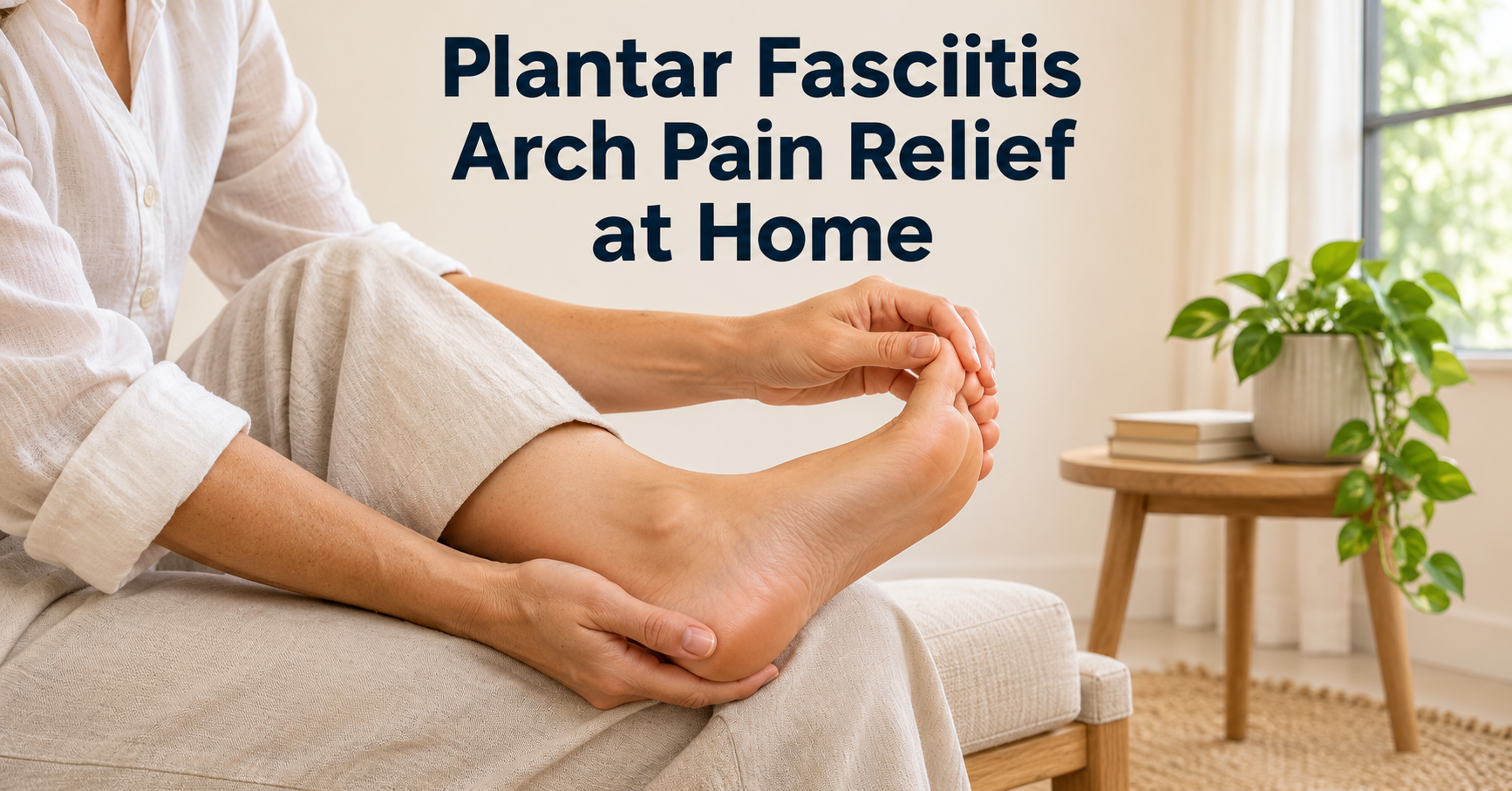
Sit in a chair and cross the sore foot over the opposite knee. Grab your toes and gently pull them back toward your shin until you feel a stretch along the arch. Run your thumb along the arch to check that it feels tight. Hold for 30 seconds and repeat three times.
2. Calf Wall Stretch
Stand facing a wall with the sore leg straight behind you and the heel on the floor. Lean forward until you feel a stretch in the calf. Hold 30 seconds, three times. Then bend the back knee slightly to target the deeper soleus muscle.
3. Golf Ball or Massage Ball Roll
Sit and place a golf ball, lacrosse ball, or a firm massage ball under your arch. Roll slowly from heel to ball of foot for two to three minutes using moderate pressure. It should feel like a tender massage, not stabbing pain.
4. Towel Scrunches
Place a small towel flat on the floor and sit with your foot on one end. Use your toes to scrunch the towel toward you. Do two sets of 15 repetitions. This strengthens the small muscles that support the arch.
5. Short-Foot Exercise
While sitting or standing, try to draw the ball of your foot toward your heel to raise the arch, without curling your toes. Hold for five seconds, then relax. Repeat ten times. It is a small movement and takes practice, but it is one of the best exercises for arch control.
6. Calf Raises
Once everyday walking is mostly comfortable, stand on both feet and slowly rise onto your toes, pause, and lower slowly over three to four seconds. Do three sets of 12. Progress to single-leg raises over time. Strong calves share the load with your arch.
7. Single-Leg Balance
Stand on one foot for 30 to 60 seconds while keeping the arch lifted. Make it harder by closing your eyes or standing on a folded towel. This trains the foot and ankle to stabilize automatically.
8. Hip Strengthening
Side-lying leg raises, glute bridges, and clamshells strengthen the hips, which helps control how your leg and foot move during each stride. Two to three sets of 10 to 15, a few times a week, is a good start.
How to Choose Running Shoes for Arch Pain
The right shoe will not fix everything, but the wrong shoe can keep your pain going indefinitely. Use these guidelines when shopping:
- Get fitted late in the day. Feet swell during the day and after activity, so an evening fitting gives you a more realistic size.
- Leave a thumb’s width in front of the toes and make sure the forefoot is wide enough for your toes to spread.
- Match the shoe to your arch. Flat or collapsing arches often feel better in stability or motion-control shoes. High arches usually prefer a neutral, well-cushioned shoe.
- Look for moderate cushioning and a firm heel counter. The heel should feel secure and not slip.
- Check that the shoe flexes where your foot flexes, at the ball of the foot, not in the middle of the arch.
- Do not rely on brand or price. Comfort and fit matter far more than marketing. If it feels good in the store, that is the best predictor.
- Rotate pairs. Using two different pairs of running shoes gives foam time to recover and varies the stress on your feet.
- Replace on time. Track your mileage and retire shoes around the 300 to 500 mile mark, or sooner if the midsole looks creased or compressed, or if your arch begins to ache again.
Also think about what you wear after the run. Supportive sandals or recovery shoes are kinder to a sore arch than going barefoot or wearing flat flip-flops.
Arch Supports and Recovery Gear Worth Considering
Many runners find that a few well-chosen products speed up recovery and reduce the chance of relapse. Here is what to look for in each category and who it suits best.
Running Insoles and Arch Supports
Best for: flat or low arches, overpronation, or arches that tire quickly.
What to look for: a firm but comfortable contoured shape, a deep heel cup, a thin enough profile to fit your running shoe, and the right arch height for your foot. Remove the original insole first so your shoe does not become too tight. Introduce new inserts gradually, wearing them for an hour or two at first, because your feet need time to adjust.
Stability or Cushioned Running Shoes
Best for: runners replacing worn shoes or switching from the wrong category.
What to look for: a secure heel, a roomy toe box, and a midsole that suits your arch type. Try them with your usual running socks and test them by jogging a few steps in the store if allowed.
Massage Ball or Foot Roller
Best for: daily self-massage of a tight arch and plantar fascia.
What to look for: a firm but not rock-hard surface, a size that fits comfortably under the foot, and, if you like cold therapy, a roller you can keep in the freezer.
Plantar Fasciitis Night Splint or Stretching Strap
Best for: sharp morning heel and arch pain that is worst with the first steps.
What to look for: adjustable straps, breathable padding, and a design you can actually sleep in. Some people find a simple stretching strap easier to use for calf and foot stretches during the day.
Compression Arch Sleeves or Socks
Best for: mild arch soreness and swelling during or after runs.
What to look for: graduated compression, a seamless design to avoid rubbing, and a snug but not tight fit. They provide gentle support and a feeling of stability, but they do not replace proper shoes or exercises.
Recovery Slides or Supportive Sandals
Best for: time spent on your feet at home and after runs.
What to look for: a contoured footbed with arch support, a cushioned heel, and a sturdy sole that does not fold in half.
Foam Roller for Calves
Best for: loosening tight calves that pull on the plantar fascia.
What to look for: medium density that is firm enough to work the muscle without causing bruising, and a length that suits your space.
Remember that no product works magic on its own. Combine gear with the exercises, training changes, and recovery habits in this guide for the best results.
How to Return to Running Safely
Once your arch is no longer painful during everyday walking and first-step pain has largely disappeared, you can restart with a gradual walk-run plan. The table below is a general example. Move to the next step only if you finish the session and the following morning with little or no pain.
| Stage | Session | Frequency |
|---|---|---|
| Stage 1 | Brisk walking, 30 minutes | Daily, pain-free |
| Stage 2 | 1 min jog / 2 min walk, repeat for 20 minutes | Every other day |
| Stage 3 | 3 min jog / 1 min walk, repeat for 25 minutes | 3 times per week |
| Stage 4 | Continuous easy run, 20 to 25 minutes on a soft, flat surface | 3 times per week |
| Stage 5 | Gradually add distance, then hills and speed work | Increase slowly week by week |
Use the “next-day rule”: a mild ache that is gone within a day is acceptable, but pain that is increasing or lingering into the next morning means you should drop back a stage. It is not unusual for the full process to take several weeks, and some cases take months, so patience pays off.
Prevention Checklist
Once you are healed, keep the pain away with a few habits:
- Increase mileage and intensity gradually, and avoid changing several things at once
- Replace running shoes before they are worn out
- Stretch calves and feet after runs, and do arch-strengthening exercises two to three times a week
- Do strength training for calves, hips, and core
- Warm up with a few minutes of walking and dynamic movement before running
- Vary your running surfaces and terrain
- Avoid going barefoot on hard floors if your arches are sensitive
- Maintain a healthy body weight, as extra load increases stress on the arch
- Allow rest days and listen to early warning signs
- Sleep well and eat enough to support tissue repair
Frequently Asked Questions
Why does my arch hurt after running but not during?
While you are running, warm tissue and adrenaline can mask discomfort. Once you cool down, the tissue stiffens and inflammation becomes noticeable. Pain that appears only after exercise is often an early warning that the arch is being overloaded.
How long does arch pain from running last?
Mild strain may settle in one to two weeks with rest and care. Plantar fasciitis and tendon problems can take several weeks to a few months to resolve fully. Stress injuries can take longer. If you are not improving after two to three weeks, get it checked.
Should I keep running with arch pain?
If the pain is mild and does not change your stride, some runners can continue with reduced volume. If it is increasing, changes how you run, or lingers into the next day, take time off from running and cross-train. Running through worsening pain can turn a small problem into a long one.
Are arch supports good for runners?
For many runners with flat or low arches, they can reduce strain and improve comfort. They work best alongside strengthening and proper shoes, not as a stand-alone fix. If over-the-counter options do not help, a professional can assess whether custom orthotics make sense.
Is arch pain the same as plantar fasciitis?
Not always. Plantar fasciitis is a very common cause, but arch pain can also come from tendon problems, muscle strain, nerve irritation, or stress injuries. The location, timing, and pattern of your pain help point to the cause, and a professional can confirm it.
Does stretching really help arch pain?
Yes, especially stretching the calves and the plantar fascia. Studies and clinical experience suggest that consistent stretching, combined with strengthening, is one of the most effective conservative treatments. The key word is consistent: a daily routine beats an occasional long session.
Can the wrong running shoes cause arch pain?
Absolutely. Worn-out shoes, shoes that do not suit your arch type, or shoes that are too narrow can all contribute. If your pain started after buying new shoes or after you passed several hundred miles in an old pair, footwear is a prime suspect.
Is walking barefoot bad for arch pain?
On hard floors, it often is while you are recovering. Soft, supportive footwear at home reduces strain. Once you are healthy, gradual barefoot or minimal-shoe work on soft surfaces can strengthen your feet, but it should be introduced slowly.
Final Thoughts
Arch pain after running is frustrating, but it is rarely a reason to give up on the sport. Understand what is driving your pain, calm the irritated tissue, rebuild strength in your feet, calves, and hips, choose shoes and support that suit your foot, and return to training in small steps. Most runners who follow this approach get back to comfortable, consistent miles.
Start tonight with two simple actions: a gentle calf and plantar fascia stretch, and a look at how many miles are on your current running shoes. Small steps today protect your runs for years to come.
Medical disclaimer: This article is for general information only and is not a substitute for professional medical advice, diagnosis, or treatment. Always consult a qualified healthcare professional about foot pain or before starting a new exercise program.
Affiliate disclosure: Some product categories mentioned in this guide may include affiliate links in the future. If you buy through them, this site may earn a small commission at no extra cost to you. Our recommendations are based on what is most useful for readers.